 Search
 Customer
Precision Testing for Reliable Engine Performance - The Importance of Coolant Analysis
By Steve Bee | VPS Group Marketing & Strategic Projects Director
Engine coolants play a critical role in protecting equipment performance, efficiency, and longevity. As cooling system technologies and coolant formulations continue to evolve, regular laboratory analysis has become an essential part of proactive maintenance.
It is widely known that Coolants should be managed with the same discipline as other critical fluids, as chemical changes can develop long before visible failures occur.
However, it must be emphasized that coolant analysis is about reliability, not just fluid condition. Modern engines and cooling systems operate under higher thermal loads and tighter tolerances, so even small changes in coolant chemistry can affect corrosion control, heat transfer, and component life.
An effective coolant analysis service should provide operators with an early warning system, helping to identify contamination, degradation, and inhibitor depletion before they become operational failures. The service can be a practical tool for reducing downtime, preventing avoidable repairs, and extending equipment life.
As stated above, many cooling system issues start at the chemical level, long before anything is visible and without analysis you are effectively blind until a failure starts. Through coolant testing, risks such as corrosion, cavitation and scale formation can be detected long before damage occurs.
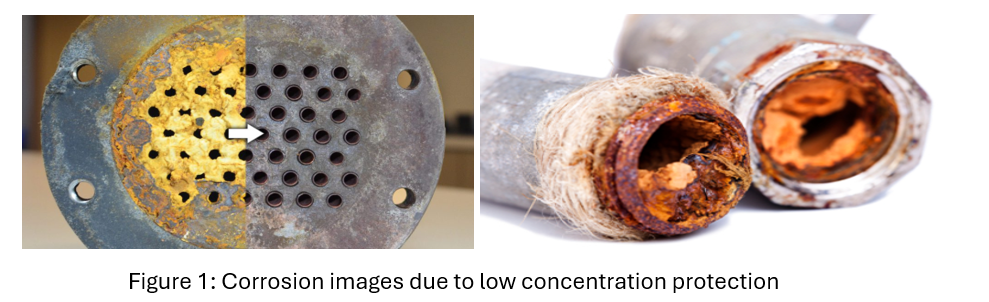
As an example, the above images show the damage that can occur when a coolant does not have sufficient concentration to provide adequate protection. This damage can appear as scale formation, reduced heat-transfer efficiency and lower flow rates, which can ultimately lead to corrosion.
Coolants don’t just control temperature, they also chemically protect engines and coolant systems. They effectively prevent corrosion of metals and components, reduce cavitation damage in liners and pumps and help avoid deposit build-up and blockages in heat exchangers. Its true that cooling system damage, is a major source of engine failure.
Coolants must be chemically stable in order to transfer heat effectively, as poor cooling performance directly impacts engine efficiency, fuel consumption and reliability. As a predictive maintenance tool coolant analysis moves operations from emergency repairs to planned maintenance.
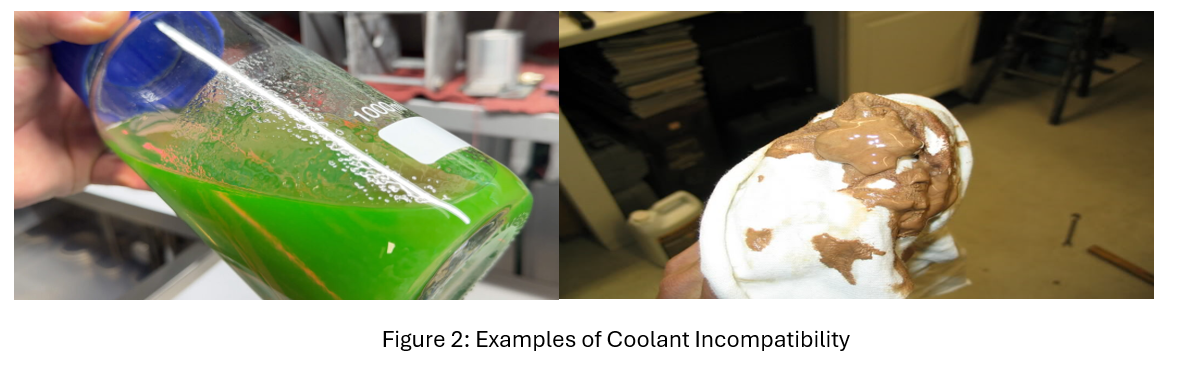
Should coolants exhibit degrees of incompatibility, then further issues can arise. Mixing incompatible coolants can cause sludge formation, which will in turn affect coolant circulation, leading to reduced efficiency. In addition incompatible coolants can form sludge or gels, which negatively impacts circulation and heat transfer creating hotspots. Those hotspots can break down lubrication and cause micro-welding between piston and liner surfaces, leading to piston pick-up.
Historically, many coolants were relatively simple glycol/water formulations supported by inorganic inhibitors such as silicates, phosphates, or borates. However, modern coolants are more sophisticated, including OAT, HOAT, NOAT, POAT, and other specialized blends designed for longer service life and improved protection. This added sophistication creates a need for verification: when systems are topped up, mixed, contaminated, or serviced.
Organic Acid Technology (OAT) coolants, can be formulated with various organic acids such as Sebacate, which is an ester of sebacic acid. Sebacate exhibits low volatility and excellent flexibility at low temperatures. Also tolytriazole can be a component, which is best known as a thermally stable, metal corrosion inhibitor.
So organic acid technology uses organic acids to provide targeted corrosion protection, especially for aluminum and mixed-metal systems. The advantages are, long service life of up to seven years, reduced abrasive deposits, and protection that is generally gentler on seals and components. However, whilst such coolants offer long service life, OAT coolants are not maintenance-free. Its also possible that coolant protection can be slow to establish and performance can be compromised by incorrect mixing, contamination, or loss of inhibitor balance. This is where routine analysis helps verify that the coolant is still doing its job.
Hybrid Organic Acid Technology (HOAT) coolants are newer generation coolants which combine organic acid technology with selected inorganic additives. They aim to provide both long-life protection and faster initial corrosion control through improved heat transfer and cooling performance. This makes them attractive for demanding engines and systems where heat transfer, compatibility, and corrosion control are all critical. The important point is that HOAT chemistry is more complex than traditional coolant chemistry. That complexity can make correct identification, compatibility, and contamination control more difficult. The downsides to HOAT coolants are they are more expensive than traditional coolants, but more concerning is they can be more susceptible to becoming contaminated, affecting their effectiveness and lifespan. Therefore, routine lab testing helps confirm whether the coolant in service still matches the intended formulation and whether the inhibitor package remains effective.
The shipping fleet has numerous sectors and each have various considerations when it comes to the use of coolants:
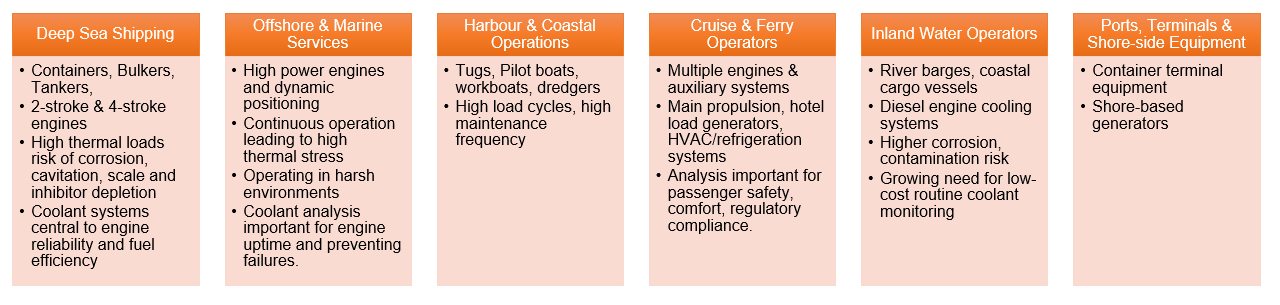
However, the underlying need for each shipping sector is similar, in that cooling-system reliability supports uptime, safety, and cost control. Deep-sea shipping, offshore and marine services, harbour and coastal operations, cruise and ferry operators, inland waterway vessels, plus port or terminal operators, all have equipment where coolant condition can affect reliability. The commercial message is that coolant analysis can be positioned alongside existing marine fluid management services, making it a logical extension rather than a separate standalone offering.
A typical coolant analysis test slate includes the following tests highlighting what each test parameter detects, their frequency and benefits:
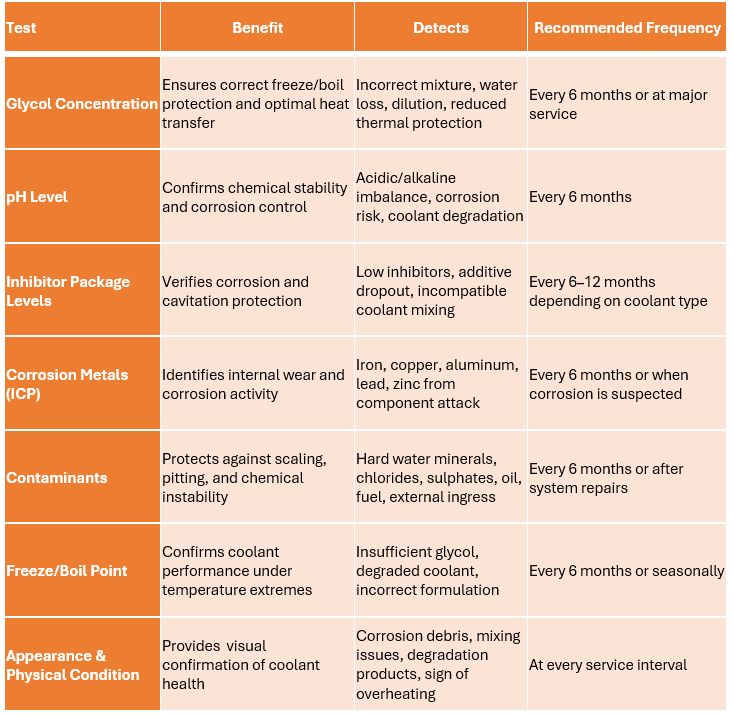
To take an analogy from Oil Condition Monitoring, Coolant Analysis is effectively a “blood test” for the cooling system.
So in summary, Coolant Analysis can prevent failures through early chemical detection, protect components, maintain performance, plus reduce costs and downtime.
For more information on how VPS can support you through coolant analysis, please contact sales@vpsveritas.com
Click on this link to take you to the VPS Website: Coolant Analysis Service | VPS